Most recent studies are posted first
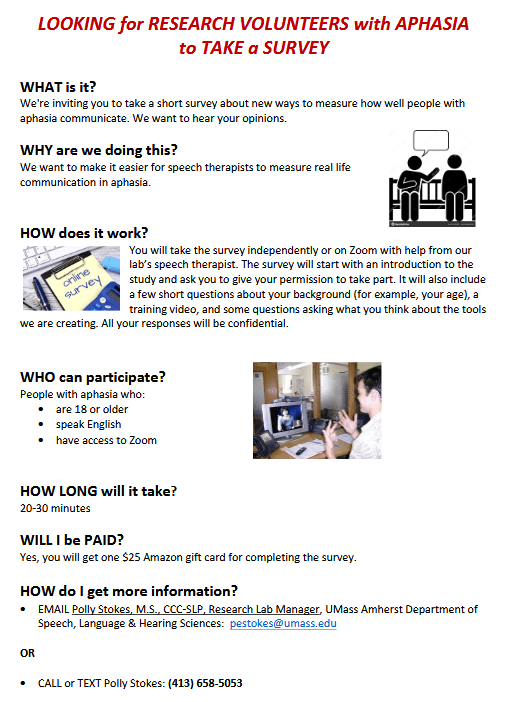
This study is a remote study on Zoom. You can take the survey on your own, or with help from the lab’s speech therapist. Contact Polly Stokes cell 413 658-5053 or email her at pestokes@umass.edu
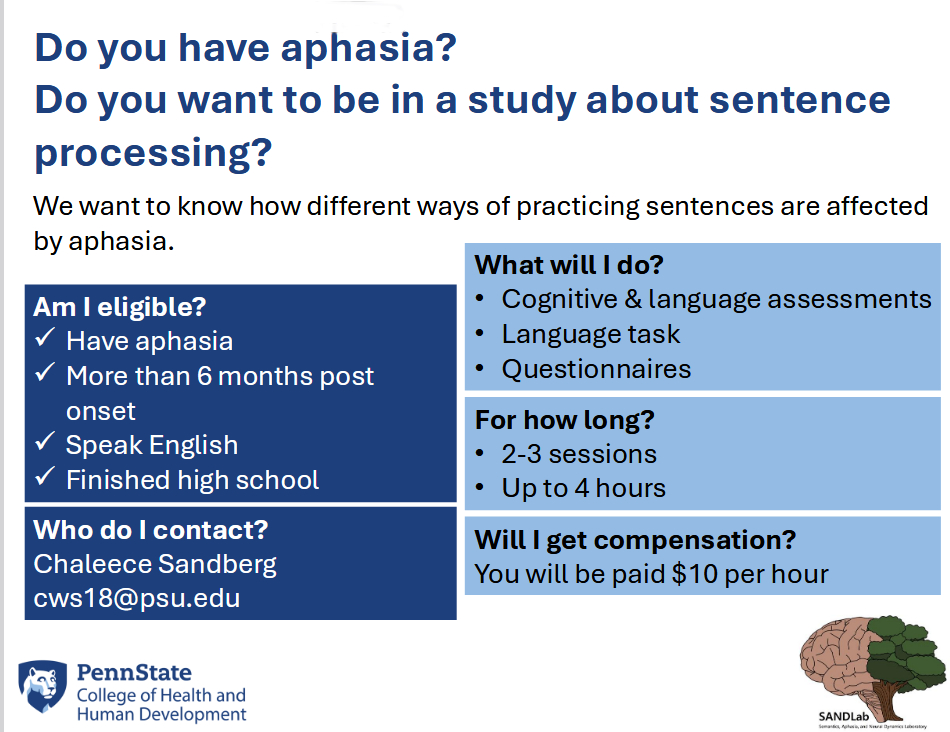
Online study of sentence therapy
This is Parisa. I am a PhD student at Pennsylvania State University. I am reaching out to introduce our research study on Aphasia to you. In this project, we aim to understand how different ways of practicing sentences are affected by aphasia. The study involves 3 online sessions, totaling four hours. All sessions are run online using a laptop. 
Please find further information in the flyer above. 
If you are interested in participating, please let me know. 
Contact Parisa Osfoori at pvo5112@psu.edu or Chaleece Sandberg at cws18@psu.edu
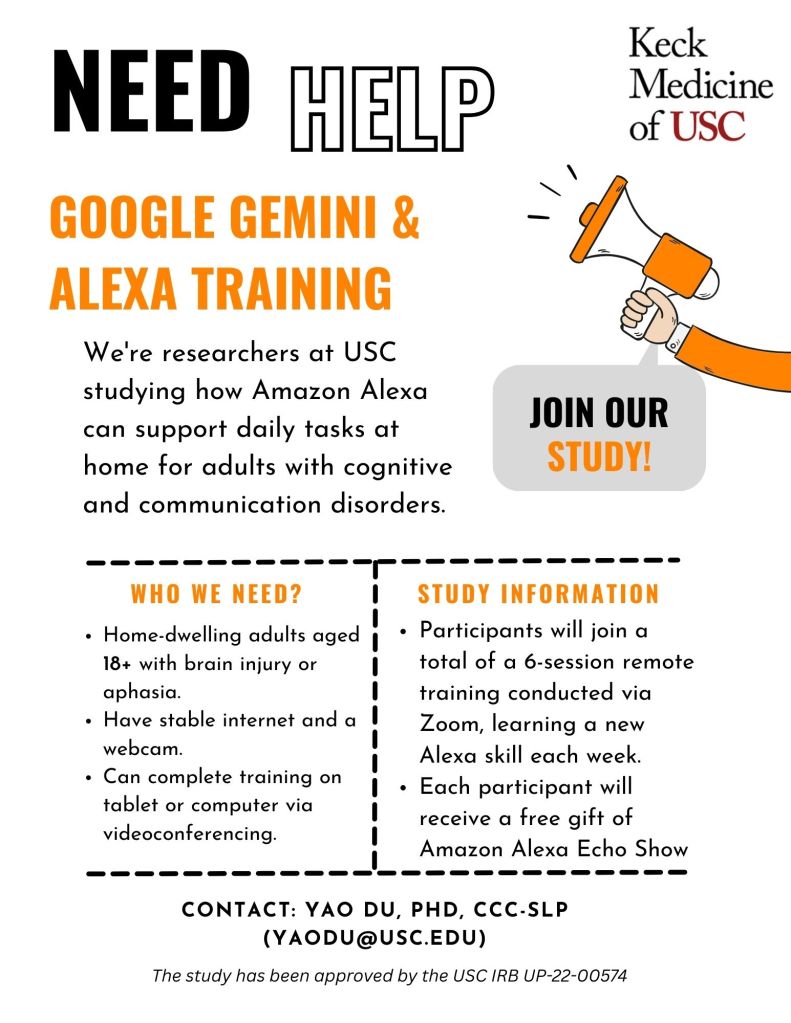
Using Alexa to help with communication and cognitive difficulties
Open to adults 18 year or above who have aphasia and/or a cognitive disorder. Training for six sessions on Zoom. Bilingual speakers are welcome. Contact Yao Du at yaodu@usc.edu
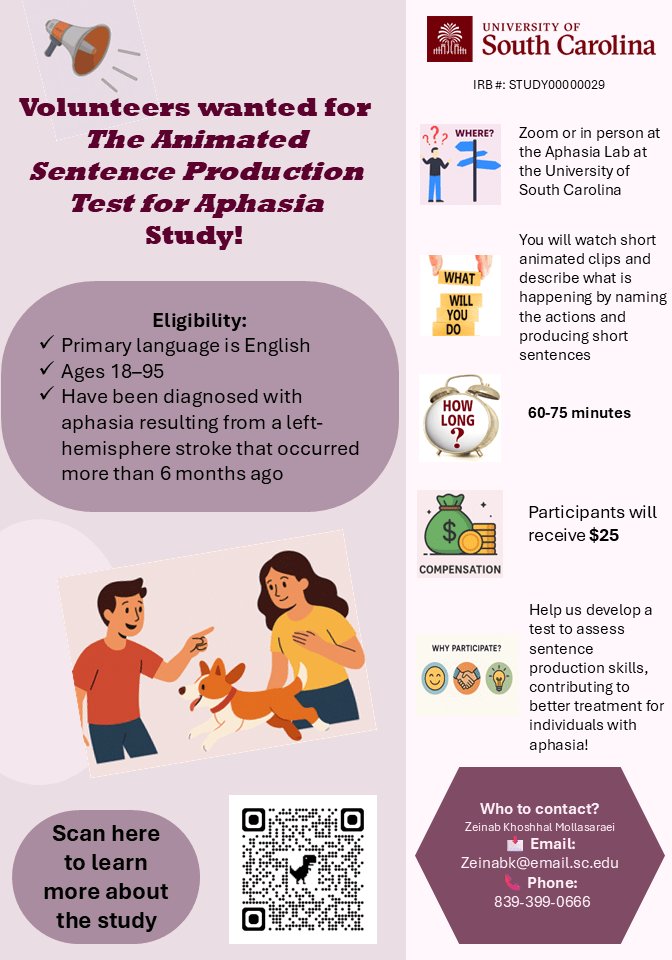
Animated Sentence Production Test
Can participate in person at University of South Carolina or online.
A naming task, takes 60-75 minutes.
Primary language should be English.
For questions or to express interest, contact Zeinab at Zeinabk@email.sc.edu or call 839 399-0666.
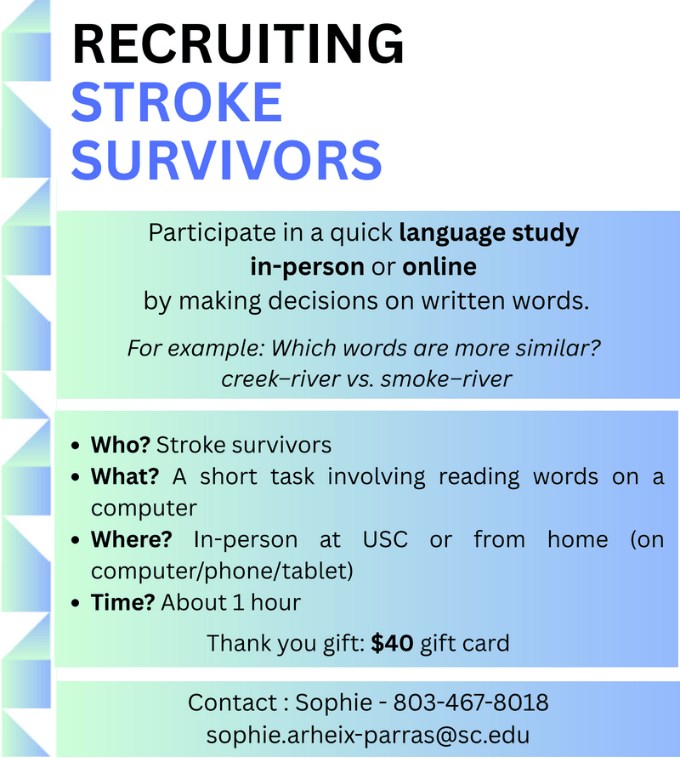
In-person or online study of processing of written words
The study takes about one hour to complete. Conducted by the University of South Carolina. For more information, contact Sophie Arheix-Parras at 803 467-8018 or sophie.arheix-parras@sc.edu
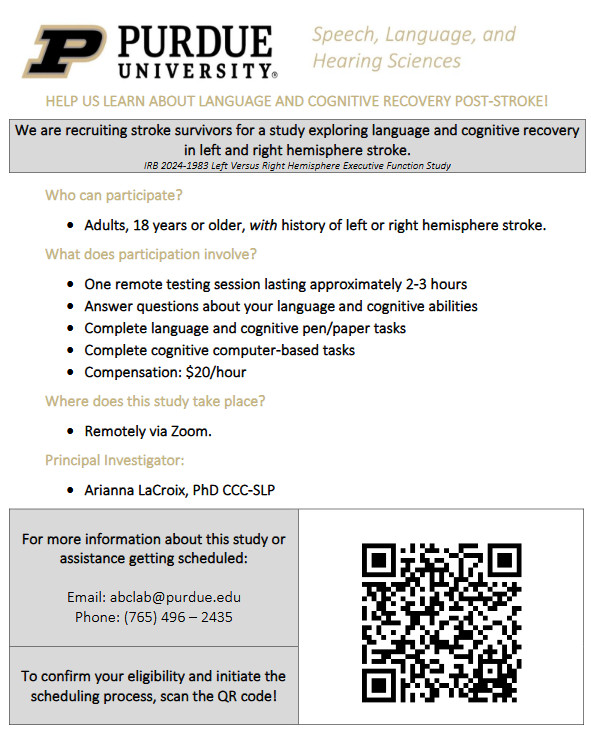
Online study of language and cognition in aphasia
Posted on March 27, 2025
Researchers at Purdue University, Iowa are studying language and cognition recovery after stroke. They are looking for people with a right or left hemisphere stroke who spoke English from before the age of 5 years old. This study is online only, and will take 2-3 hours. If you have more questions, or are interested in participating, contact abclab@purdue.edu or call 765 496-2435.
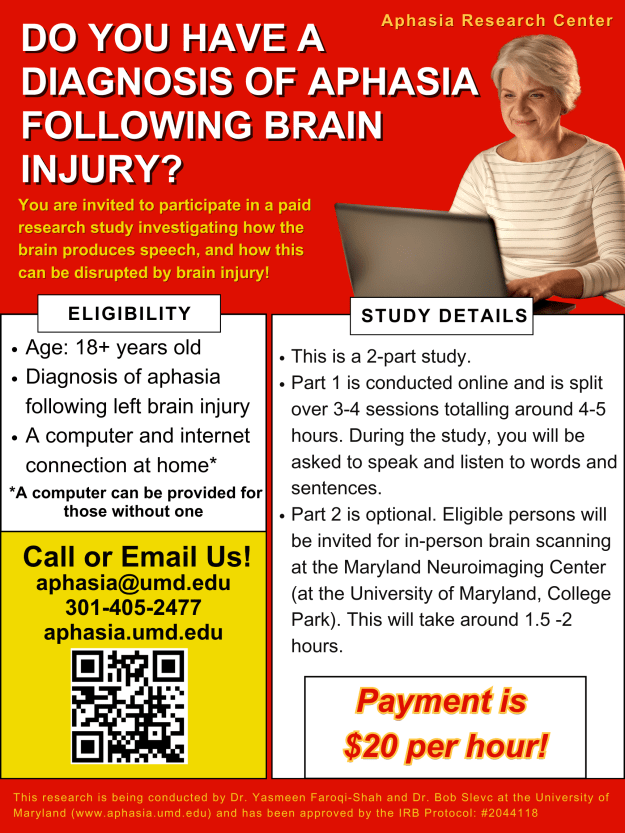
Online study of aphasia in head injury survivors
Posted on March 10, 2025
Researchers at the University of Maryland are studying speech and comprehension after left sided brain injury. This study is recruiting speakers of English only. The first part of the study can be done online. The optional second part of the study involves a brain scan at the University of Maryland, College Park MD. To learn more, or to express interest, call 301 405-2477, or email aphasia@umd.edu
For more about aphasia research studies at the University of Maryland, go to https://sites.google.com/view/aphasia-umd-edu/

Online Eye Tracking Study
Posted February 6, 2025
Dr. Willem van Boxtel from Louisiana State University is studying eye tracking during aphasia communication. Participants should be monolingual English speakers with normal corrected vision and hearing. To learn more, or to express interest, contact pelicanlab@lsu.edu or call 225 578-7600, or scan the QR code above.
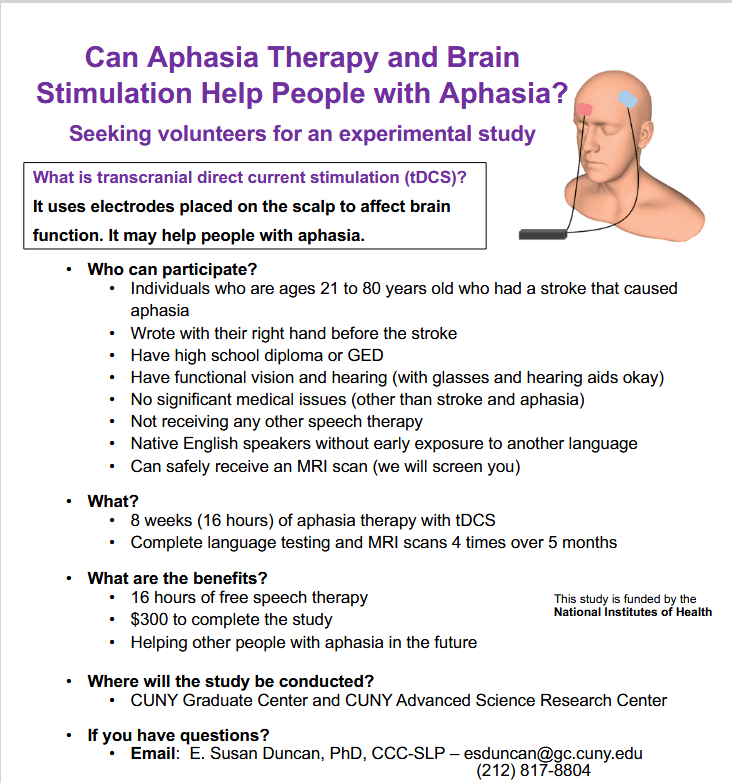
Can Aphasia Therapy and Brain Stimulation Help People with Aphasia?
Posted February 6, 2025
This is an on-site study of the use of transcortical stimulation and aphasia therapy to help people with aphasia improve their use of language. The study involves complete language testing, four MRI’s, and 8 weeks of free aphasia therapy. People who complete the study will receive $300.
If you have questions or to express interest, contact Susan Duncan at esduncan@gc.cuny.edu or call 212 817-8804.

Measuring Sleep in Aphasia
Posted January 26, 2025
My name is Emily Goldberg and I am a PhD student and speech language pathologist. I’m currently recruiting people with aphasia across the country to participate in my research study.
The research lab is located in Pittsburgh, Pennsylvania, but you can participate remotely.
Here is a link to the flyer in pdf format.
Please contact Emily Goldberg at ebg9@pitt.edu or call her at 610 731-5041 for further information.
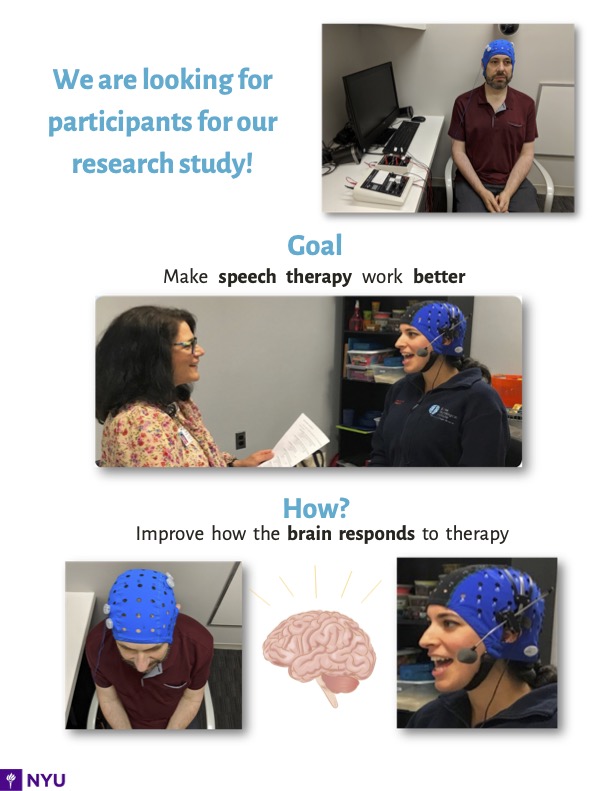
NYU In-person speech-therapy study
for stroke survivors with apraxia
Posted November 22, 2024
This research is being conducted in New York City. Qualifying participants will receive up to 24 sessions of speech therapy over a period of 4 to 6 months, at no charge.
For further information, go to https://wp.nyu.edu/buchwaldlab/stroke-rehab
or email buchwald-lab@nyu.edu
or call 646-612-0284

University of Illinois’s Speech Accessibility Project
Received November 1, 2024
This appears to be an online research project.
The following information is taken from
https://lingraphica.com/university-of-illinois-speech-accessibility-project
The University of Illinois’s Speech Accessibility Project, with Lingraphica and other leaders as partners, has one goal: to improve speech technology for people with a range of diverse speech patterns and disabilities.
And we need your help.
By joining this study, you’ll contribute to groundbreaking research that aims to improve voice recognition for people with speech conditions. This is your chance to shape the future and ensure technology is accessible to everyone.
Who Are We Looking For?
We are looking for adults of all ages who meet all of the following criteria:
- Have a speech and/or language impairment from stroke
- Can answer yes/no questions
- Can follow basic instructions
- Can read OR repeat simple sentences
- Have Internet access with computer or tablet
- Have someone who can help you log on or can log on independently
- Does NOT reside in Texas, Illinois, or Washington states
What Will You Be Doing?
From the comfort of your home, you will be asked to record sentences and answer questions on the Speech Accessibility Project website. You will record 600 speech samples and will have up to three months to complete the recordings. It will take you about 7 hours. You can record a lot or a little at a time. You will be paid up to $180. Your helper can earn up to $90.
For more information, go to
https://lingraphica.com/university-of-illinois-speech-accessibility-project
and fill out the form at the bottom of the page.
APEX Study and Aphasia Recovery Lab
On November 11, 2024, we heard a fascinating account of using intermittent intense exercise to help recovery from aphasia. This was an in-person study in San Francisco. They are not currently seeking participants, but hope to have a bigger study in about six months. For more information, or to be considered for future studies, contact Dr. Maria Ivanova at ivanova@berkeley.edu
For more inforamation about the Aphasia Recovery Lab, go to https://aphasia.studentorg.berkeley.edu/
People with Aphasia
for a Research Study about Intimacy & Aphasia
for more information, contact Laura Wolford, PhD, MS CCC-SLP, CSE Iwolford@mghihp.edu
Measuring Life with Aphasia
For more information, see the YouTube video below
and contact Shannan Love slove@ualberta.ca
 iamaphasia